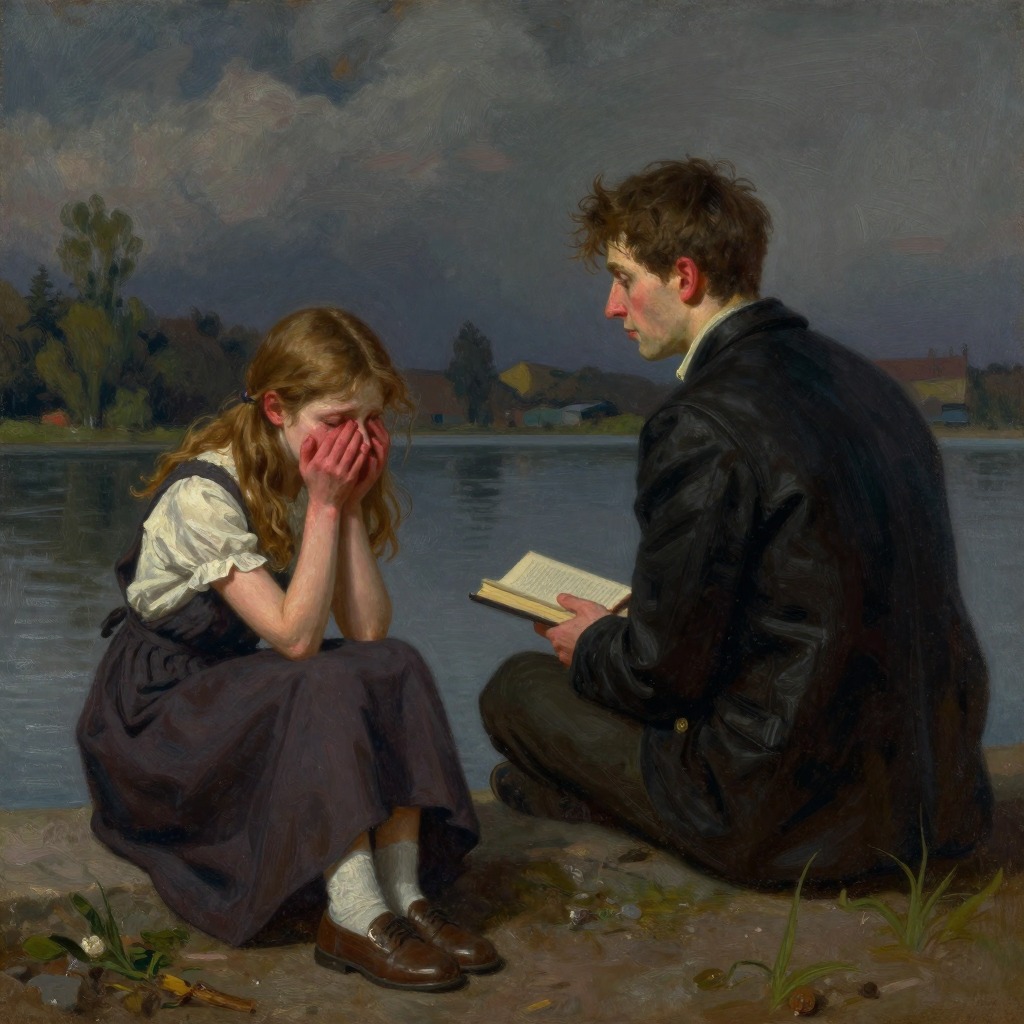
knotted stick
The knotted stick is a modest but pivotal object in Fyodor Dostoevsky's "White Nights," appearing at three crucial junctures: as the instrument that enables the Dreamer to rescue Nastenka from a drunken pursuer, as a prop in the Dreamer's self-description of his solitary habits, and as a final domestic detail that Matrona, the housekeeper, mentions after the story's emotional climax. More than a mere accessory, the stick marks the Dreamer's single moment of decisive, physical action in a narrative otherwise dominated by passivity and fantasy, and its reappearance in the story's closing scene underscores the return to ordinary life after the white nights' extraordinary events.
First Appearance: The Rescue on the Canal Embankment
The knotted stick first appears on the First Night, when the Dreamer, walking home along the Canal Embankment, encounters a young woman—Nastenka—leaning on the railing and crying. After she walks away, a drunken gentleman in evening dress begins to pursue her. The Dreamer, who describes himself as timid with women and unaccustomed to action, suddenly finds himself crossing the street: "in a flash I was on the other side of the street; in a flash the obtrusive gentleman had taken in the position, had grasped the irresistible argument, fallen back without a word." The "irresistible argument" is the knotted stick, which the Dreamer blesses as "my good luck for the excellent knotted stick, which happened on that occasion to be in my right hand." This moment is the Dreamer's only physical intervention in the entire story; it transforms him from a passive observer into a protector, and it directly leads to his first conversation with Nastenka, who takes his arm and walks home with him.
Second Appearance: The Dreamer's Self-Portrait
The stick reappears in the Dreamer's elaborate self-description during the Second Night, when he explains to Nastenka what it means to be a "dreamer." In his account of his daily walks, he mentions an old man he meets every day on the Fontanka—"Such a grave, pensive countenance; he is always whispering to himself and brandishing his left arm, while in his right hand he holds a long gnarled stick with a gold knob." This old man, who notices the Dreamer and takes a warm interest in him, is the only person with whom the Dreamer has even a silent, ritual acquaintance. The stick here is not the Dreamer's own but belongs to a figure who mirrors his own solitary, ritualized existence. The contrast between the old man's ornamental, gold-knobbed stick—a symbol of dignified, habitual routine—and the Dreamer's own "excellent knotted stick," used for a single act of decisive intervention, highlights the difference between the Dreamer's fantasy life and his rare, real-world action.
Third Appearance: The Return to Ordinary Life
The knotted stick makes its final appearance in the story's closing "Morning" section, after the Dreamer has read Nastenka's farewell letter and is sitting in his room, overwhelmed by grief. Matrona, his housekeeper, enters and announces: "I have taken all the cobwebs off the ceiling; you can have a wedding or give a party." This mundane, practical remark—the only mention of the stick in this scene—is the housekeeper's way of noting that she has cleaned the room, a task that involves using a stick or broom to reach the ceiling. The stick here is no longer a weapon or a symbol but a humble household tool, part of the daily labor that continues regardless of the Dreamer's emotional devastation. Its appearance in this context underscores the story's final movement: the return from the heightened, romantic world of the white nights to the gray, ordinary reality of the Dreamer's solitary life, where Matrona's cleaning and the cobwebs on the ceiling are the enduring facts.
Thematic Significance: Agency, Protection, and the Ordinary
Across its three appearances, the knotted stick traces an arc from decisive action to symbolic routine to domestic banality. It is the only object through which the Dreamer exerts physical agency in the external world, and it directly enables the central relationship of the story. Yet its final appearance, as part of Matrona's cleaning, reminds the reader that the stick is also an ordinary object, one that belongs to the world of everyday life that the Dreamer both flees and is ultimately returned to. The stick thus becomes a quiet emblem of the story's central tension: the conflict between the dreamer's inner world of fantasy and the outer world of concrete action, and the inevitable return to the latter when the white nights end.